This a translated version of a Korean blogger named IMPeter - This is the most well researched and most thoroughly presented blog, questioning the validity of criticisms launched against Holt and intercountry adoption after the incident involving the death of Hyunsu O'Callaghan. I have never met the author, but apparently his blog is one of the most widely read blog in Korea. He has over 500,000 followers and is one of the most famous political analyst in Korea.
The original link for IMPeter blog is at: http://impeter.tistory.com/2439 (Korean).
현수 '해외입양' 책임, 과연 누구에게 있나?
Hyunsu’s ‘Intercountry Adoption’ Who is to Blame?
A Korean child who was adopted abroad
died in February of this year. The boy’s
adoptive father is facing first degree murder charges as the Korean boy was
allegedly killed by him four months after the adoption.
Through this unfortunate event, the
media and some civil organizations have placed blame on ‘Holt Children’s
Services’.
Of
course, Holt is responsible in some measure as the agency that placed Hyunsu
for intercountry adoption (ICA). However, it was very disappointing to watch
all the media launch unwarranted attacks against Holt and adoption without
fully understanding the complexities involved with the current system of
adoption.
I wish
to examine the facts regarding Hyunsu’s death and hope to clear away some
misunderstandings and questions related to ICA.
I first posted this writing on March 18th,
and I revised it and reposted on March 21st. There are several reasons for my revision.
1. Hyunsu’s birthmother does not wish to have
his face continue to appear, so I used a mosaic effect to block his face.
2. A minor correction was made regarding the items purchased for Hyunsu that
was included in the adoption expenses.
3.
The foster mother’s disqualification to adopt domestically.
4.
Reexamination of the earlier data obtained for accuracy.
5.
Some civil organizations’ negative reaction to Holt’s claim.
(If you downloaded the earlier blog, please at least, mosaic out Hyunsu’s face)
#The main cause of death is due to Holt’s failure
to better investigate?
Most
media has blamed that the death was attributable to Holt’s failure to properly
investigate the adoptive parents. But
IMPeter has obtained many documents used to investigate the adoptive parents
from Holt.
<Hyunsu’s
Adoption Documents>
Adoptive
parents’ report,
Homestudy,
original to the Department
of Homeland Security
Statement
of Adoption (Original)
Parents’
Medical Reports
Statement
of Religious Freedom
Criminal
Investigation Report (FBI)
Child
Abuse History Report
Alcohol
and Drug Use Investigation
Physician’s
statement on physical and mental examination
Youth
custody evaluation survey (To prevent child abuse)
Parents’ Certificate of Adoption Education
Adoptive
Parents Credentials
Financial
Reports
In
particular, the adoptive father, Mr. O’Callaghan was examined by the Maryland
Child Services four different times, and because he served in the military, his
military service record was added (To examine any record of disciplinary
actions or psychological problems).
Steve Morrison is an adoptee, and in his
letter to Representative Min Hyun Ju and the Family Court Justices, he noted
that despite the most rigorous investigation methods used by the NSA, they
could not find any flaws with Mr. O’Callaghan.
■ Even the NSA’s rigorous investigation could not detect a flaw in O’Callaghan
The NSA in the US is a national security agency, and to qualify to work at this agency requires the most rigorous type of background investigation. But despite such stringent examination, the NSA could not detect a flaw in him.
In order to be employed by the NSA, one must go through a physical exam, Polygraph lie detection interview, psychological tests, drug tests, past residence history, etc. To be in a position like the one Brian O’Callaghan had, one has to be cleared to have top secret clearance that lasts anywhere from 3–12 months. The NSA conducts various psychological tests to weed out any undesirable candidates. You may learn more about the methods used by the NSA to investigate a potential employee at (http://work.chron.com/process-nsa-intelligence-analyst-interview- 16430.html) It is impossible for an adoption agency to investigate a potential parent to the level equal to NSA. They lack the resources and manpower and finances to conduct such tests. How can one expect an agency to find a flaw that NSA could not? That is why O’Callaghan’s alleged crime (if he gets convicted in the trial) is really out of the norm and very exceptional, and it is not due to the adoption process.
Hyunsu’s
adoptive parents visited Korea three times and have met with him ten different
times, and they went through the 13-hour adoption education that touched on
‘What it means to have a multi-cultural familiy,’ ‘The impacts upon a child
before and after the adoption,’ ‘Developmental Risk Factors,’ and other
topics.
Unlike how the media has portrayed them, the homestudy document produced by
Holt clearly shows that their investigation was very thorough, and it was
difficult to see that Holt has been negligent in finding good parents for
children.
Below is the Post Placement Service Report on
Hyunsu prepared by the Catholics Charities Child and Family Services.
The
media has blamed Holt, that they did not do its job well regarding Hyunsu’s ICA
post- placement service. But this is
different from the truth. The American
agency in charge of Hyunsu, the Catholics Charities has submitted to Holt the child
post placement reports after his adoption on October 26th. They also submitted to Holt the
post-placement service reports on November 11th and on December 20th.
The requirement by the Special Adoption Law
is that the post-placement service reports be submitted until the time a child
is granted citizenship. However, at
Holt, they have a requirement to submit at minimum three post-placement service
reports within a year.
IAMPeter
is convinced after reviewing many of the documents, that rather than blaming
Holt for the lack of investigation, I feel the need to offer a more fundamental
solution.
The
activists and a few civil organizations that are against ICA have accused Holt
for having adoption fees that are very high.
However, one cannot reduce overhead expenses and hope that there is no
impact on the investigation. In fact, this is nonsense. If a more thorough investigation is required,
then more expenses are involved, and if budget is reduced to investigate, then the
investigative efforts will become weak.
Perhaps
the Korean Government could get involved with the investigative aspects of ICA
and domestic adoption, and only approve couples that have passed the
investigation to adopt. (Except that this may produce other problems as the
social workers may be overloaded and other unforeseen problems may arise. So a separate budget and resources need to be
planned).
# Holt’s Purpose in
ICA is Because of Money?
Many
have been misled into thinking that intercountry adoption agencies prefer to
send children abroad to charge higher fees to make greater profits. But IAMPeter has examined the data and this
is also not true.
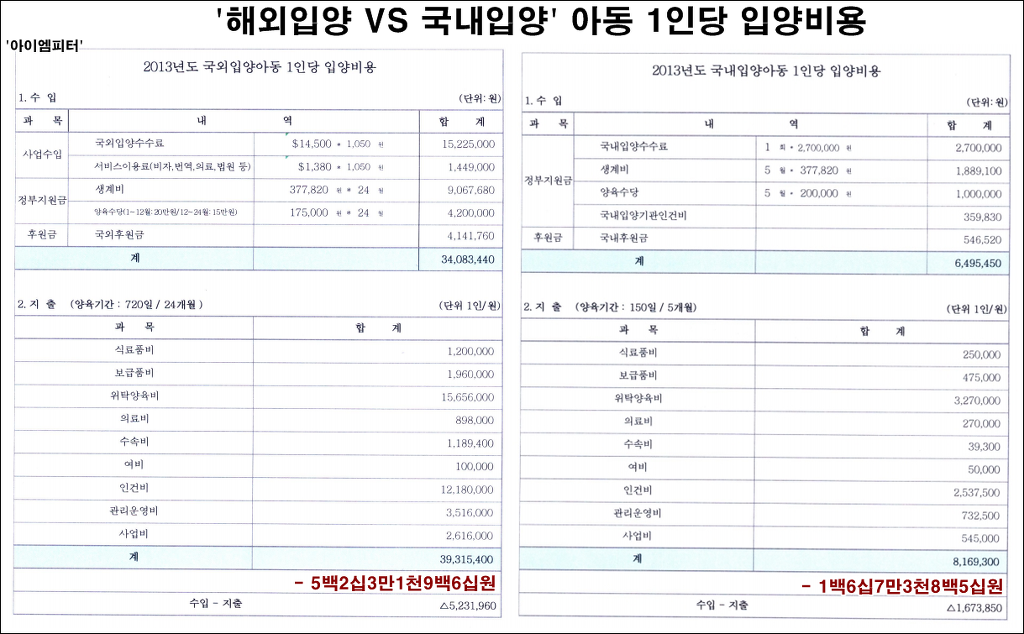
The
Table below breaks down the revenue and expense comparison between a child
adopted through ICA and a child adopted domestically in Korea for the year
2013. The table assumes $1 = ₩1,060, and
assumes that the agency holds a child for 24 months before being placed
overseas. So using this data, the total
ICA revenue that Holt receives per child is $32,304 ($14,500 for overseas adoption
fee, $1,380 for medical/visa/translation fee, $12,517 support from the Korean
Government during 24 months, and $3,907 for an overseas sponsor program).
But the
table also shows the expenses involved during the 24-month span while Holt is
holding a child. The total expense per
child is $37,090. This results in the
loss of $4,786 when sending a child overseas.
In the
domestic adoption category, the total revenue per child is $6,128 per child,
but the expense involved (based on only a 5-months holding period) is $7,707
per child, thus resulting in a loss of $1,579 per child.
So the
bottom line is that Holt experiences a greater financial loss for sending child
overseas (-$4,786) than placing a child domestically (-$1,579).
The claim that
the adoption fee for ICA is higher than the domestic adoption fee is true. However, when you factor in the expenses
involved, the loss due to ICA is greater than that of domestic adoption.
The
average time a child is in custody by Holt is 27 months, and during that time
the total expenses involved for a child was $37,090. Holt has on average
experienced minus $4,786, and this is not covered by the adoption fee, but by
the sponsorship donations received by Holt.
In the case of
Hyunsu, it was difficult to find a home in Korea, and up to the time he was
placed overseas, the expenses accumulated for his medical needs far exceeded
that of a healthy child being placed domestically.
In 2008, Holt had received an audit on their finances related to the adoption
fees. The problem lies with the ever
increasing length of time the agency has to keep a child before placing
overseas, which causes increased expenses.
Therefore to complain that the ICA cost is too high is really
meaningless.
In order
to resolve the accusations placed on Holt by the civil organizations, the
Ministry of Health and Welfare must examine the financial reports submitted by
the agencies, and make their reports on adoption fees public.
# More Domestic Adoption than ICA at Holt
Many people think that the number of
adoptions through ICA is bigger than that of domestic adoptions, but
surprisingly the number of ICA is small.
The reason is that compared to the domestic adoption, the ICA is much
more complicated and expensive.
In order to place a child overseas, the child
must be held in Korea for five months as the Special Adoption Law has put
greater priority in domestic placement of a child. This is the reason why the ICA is on the decline.
The figure below shows the decline in adoption
for both domestic and ICA. The blue bar
indicates the number of domestic adoptions while the red bar denotes ICA.
The media
ignores these facts and continues to sensationalize with the use of such old
terms as ‘Orphan Exporting Nation’ and falsely portrays Holt’s number of
overseas adoption to be larger than the number of domestic adoptions.
But during the past three years, the total number of domestic adoption was
1,153 (61%) while the ICA was 722 (39%).
If Holt
was interested in making money, then there would be no reason why they would
return 171 children to their biological families during the past three
years.
# Why
Hyunsu Had to be Placed Overseas?
Holt has worked
with Hyunsu’s birthmother, who relinquished him for adoption on June 17, 2010,
and up to the time when the boy was assigned for ICA on August 23, 2012. For 26 months Holt encouraged Hyunsu’s
birthmother to keep him or look for domestic adoption options.
<Holt’s
Efforts to Return Hyunsu to His Birthmother>
Aug 2, 2010, Hyunsu’s birthmother brought him over to
Holt’s office for the first time, brought clothes and gifts for Hyunsu to keep
(suggested the birthmother to keep the baby).
Oct 29, 2010, Hyunsu’s birthmother
showed up at the hospital where Hyunsu was being treated (Recommended birthmother
to take Hyunsu back).
Feb 13, 2012, The birthmother requested
a meeting with Hyunsu. Met at the Holt
office (Another recommendation made to take Hyunsu back).
Holt
has continually asked the birthmother to take the custody of the child, but the
birthmother was firm in placing him up for adoption.
IMPeter
has learned that Holt had met with Hyunsu’s birthmother on three different
occasions and encouraged her to take him back.
However, despite the continued efforts, the birthmother maintained that
it would not be possible for her to raise him.
Holt has made efforts to find a family in
Korea to adopt Hyunsu, but was not successful.
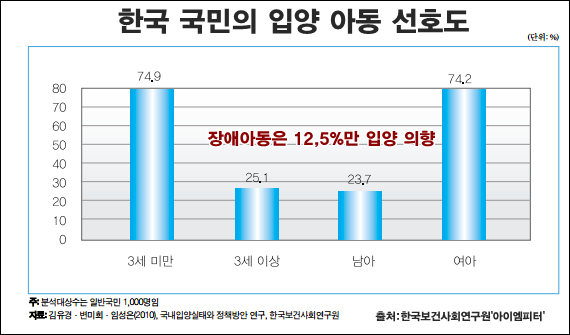
Below is a figure on a child age/gender
preference for domestic Korean adoptions:
74.9% prefer under 3 years old, 25.1% prefer ages 3 and up, and 23.7%
prefer males whereas 74.2% want females.
The biggest reason why Hyunsu could not find
a home in Korea was that he was born premature, and he had special needs:
hydrocephalus (water on the brain), language delay, and developmental
delay. 74.2 % of Koreans prefer females
(23.7% prefer males), and only12.5% are open to special needs children.
There is hardly anyone who would adopt a
special needs boy like Hyunsu in Korea, and this is the reason why ICA may not
go away.
Some
have advocated that despite these factors, adoption should not have happened.
But if a special needs child is forbidden to be adopted abroad, the child must
grow up in an institution or a special needs facility. However, in consideration of the prejudice
and social stigma the child must endure in Korea, forbidding intercountry
adoption regardless of these prejudices is not the best (right) choice for the
child.
Below is a graphic illustrating the ICA
process that Hyunsu went through. He was
born May 7, 2010, relinquished at the agency on June 17, 2010, placed for ICA
on December 3, 2010, adoptive family identified on August 23, 2012, and
departed for US on October 26, 2013.
Hyunsu was born in May 2010 and was relinquished
by the birthmother, and could not find a family in Korea during the six months
holding period (most likely) due to his special needs status.
Subsequently after 20 months of looking for a
family overseas, the O’Callaghan family was identified on August 23, 2013. A
year after the adoptive family was found, and after final adoption was granted,
Hyunsu left for America on October 26, 2013.
Below is an image of a news article that
appeared in the Korea Times regarding Hyunsu’s former foster mother who claimed
that she wanted to adopt Hyunsu but Holt rejected her. The headline of the article reads, “Hyunsu, I
wanted to adopt him in Korea…”
▲Hyunsu’s
foster mother’s interview with Korea Times (The original photo in the article had Hyunsu’s
face shown, but IMPeter mosaic-ed out his face at birthmother’s request)
Some
media interviewed Hyunsu’s former foster mother and stated that Holt had chosen
to send Hyunsu overseas despite the foster mother’s desire to adopt him
domestically.
Hyunsu’s foster mother cared for Hyunsu from
June 17, 2010 to January 20, 2011. The foster mother’s license to foster was
revoked after Hyunsu was recalled back to the Seoul office on May 23,
2012. The reason for the revocation was
that the foster mother had two foster children from Holt, and two other
children through another agency, thus totaling four children. (By regulation
foster parents cannot foster more than two children at a time).
In the media Hyunsu’s foster mother claims that she had expressed a desire to
adopt Hyunsu, upon further probing she had never officially applied for
adoption (an adoption process can only proceed with the application of
documents).
It was said in the media that foster mothers
are not allowed to adopt the children they are fostering, but IMPeter has found
out that there have been 38 such adoptions through Holt in the past.
# Problems with Adoption is due to Ignoring
the Reality
After the enactment of the Special Adoption Law, there has been 208
children who were abandoned through the ‘Baby Box’.
As the media covered the ‘Baby Box’
stories, it became apparent that the media did not feature the information that
birthmothers needed to see or hear, especially the problems resulting from the
Special Adoption Law.
1. A baby
left in the Baby Box can be adopted?
The
birthmothers mistakenly think that by putting their babies in the Bab Box they
will be adopted domestically or through ICA.
But the children abandoned through the Baby Box cannot be adopted
because of the law.
In order to place a baby for adoption, one
must receive an approval from the Family Court, and according to the Special
Adoption Law Article 12, a child must receive consent from the birth
parents. Without the approval from the
birth parents, the children are sent over to institutions where they will grow
up without being adopted.
2. Birth
Records Gets Erased?
According
to the law, an adoption is only possible if a baby is registered in to a family
registry record. This is the reason why many birthmothers abandon their babies
to remain anonymous.
Some believe that once a child has been
registered and relinquished for adoption, the registration record will be
removed. This is true. However, the
average adoption process takes over two years.
Because the registration record remains until a child is officially
adopted, and during that time the mother is unable to get a job or get married,
this results in them choosing the unthinkable.
3. Adoptees
are Better Able to Find Their Birth Parents?
Each
year many adult adoptees visit Korea to look for their birth parents. For those
who are in support of the Special Adoption Law, their claim is that the law
provides easier access to records that will help them find their birth
parents.
This is
different from the reality. It is true
that adoptees can access the records containing information on birth
parents. However, if a birth parent
chooses not to make the records available, then the adoptees cannot access
them.
Since 1980, the adoption agencies have maintained most of the records on birth
parents. This has resulted in many
meetings between the adoptees and their birth parents.
Since the new law, the law does not allow
access to the records of birthmothers, and this has resulted in the agencies
not being able to help with the birth parent searches.
The domestic
adoption agencies make efforts to encourage biological parents to stay together
as a family. Despite all the efforts
being made to encourage the birthmothers to keep their children, they continue
to give up their children.
The table below shows the rationale as to why
unwed mothers choose adoption. According
to the 2010 data, there were 16,034 single mothers in Korea. There were 2,262 babies from unwed mothers
consisting of 91.8% of all adoptions taking place in 2010. The financial support given to unwed mothers
who are 24 years and under was $142 per month, and for those over the age of 24
were given $66 per month (up to the child’s 5th birthday). Strong
social stigma against unwed mothers was another reason for them to not be able
to keep their children as 89% attributed this as the reason. 78.6% cited the economic challenges as the
reason for not being able to raise their children after they have decided to
keep their children.
#
Fix These Before Ending the ICA
IMPeter
in no way is stating that Holt’s adoption system is perfect, nor claims that
Hyunsu’s adoptive father is innocent (as he is waiting for trial and the
results are not known) and I am not overly pushing to favor ICA in any way.
However,
we must be careful not to believe over-sensationalized news articles that are
wrong, but objectively examine the whole issue of adoption and look at the
issue of adoption with a keen mind.
[Notes
on the figure below] The figure below shows some examples of benefits provided
to unwed mothers. In Germany, unwed
mothers are provided with $1500–$2500 cost of living expenses (didn’t say
whether monthly or annually, my guess is annually) depending on their income
level. The unwed mothers are given 14
months of maternity leave with up to $2,500 per month assistance, and
assistance provided to continue with their education.
In
England, the unwed mothers are provided with educational expenses ranging from
$35–$50 per month. It also includes $270
per child assistance, and depending on the number of hours worked, they are
given an income subsidy of $80–$100 per week.
They also provide educational programs such as ‘Sure Start’ to train the
unwed mothers.
In
France, unwed mothers are assisted with monthly increase of $120 /month on top
of their basic family benefits of $480.
For unwed mothers with no income, they provide $800 monthly support, and
for each child, an additional $1050 per month is provided. Also unwed mothers are provided up to $380
per month for educational subsidy.
In
these countries, the social stigma against unwed mothers is not that prevalent,
and it is possible to live off of the assistance provided by the
government.
However for Korea, where unwed
births are on the rise in a society filled with social stigma against unwed
mothers, Korea is telling unwed mothers to raise their own children with the
meager assistance of only $140 per month.
People need to look at ‘adoption’ from the
reality where in Korea, the system is such that even if an unwed mother wishes
to keep her baby, she is not able to.
[Notes
on above figure] Instead of forcibly
trying to put an end to ICA, the Government must pay closer attention in making
it possible for keeping the biological families together and promote domestic
adoption through social consensus.
At
minimum, the unwed mothers must be given the same amount the government spends
to keep a child in an institution, which is approximately $990 per child per
month. Laws must be created to protect
discrimination against unwed mothers (i.e. figure above mentions punishing a
school official that makes an unwed mother quit school).
If an
unwed mother can’t keep her child, the government must provide a favorable
adoption system, as the child is better off being adopted to a good family than
to live in an institution.
We criticize ICA and paint it as an
evil practice, and yet we shirk away from adopting our own children, and we
turn our face away from the children simply because they have special
needs.
Hyunsu’s death has made many to pick
up stones and cast them at Holt and other agencies. But is it right to cast stones at them? We
are labeling the adopted children as ‘unwanted children’ and we undermine their
character by taking away the opportunities they deserve.
One can oppose adoption for the sake
of protecting a child. But there are children and families where this is the
only option available. To ruthlessly
oppose adoption, without due regards for making any efforts to remove the
social stigma or improving the family structure in society, will infringe on
the children’s basic human rights for care and protection.
The connection between unfortunate circumstances where a child cannot live with
his birth parents to an opportunity that leads across the valley of pain, this
connecting bridge is called ‘adoption.’ Instead of unreasonably opposing
adoption and casting a stone of condemnation, we as citizens of this nation
must build a stronger bridge for our children.